Sunday, February 5, 2012
Joined Twitter!
Follow @wordyhughes
I'd been waiting until I had an iPhone to join Twitter. I'm really looking forward to connecting with bloggers and the book world in a whole new Twitterific way ^_^
Woot Woot! I'm trying to find everyone, so if I haven't found you, follow me and I'll follow you back!


Thursday, February 2, 2012
Behind the Story: Things Blow Up
 Behind the Story posts will be about what goes on behind the scenes as a writer creates their story. I'll be writing about my own writing process and sharing any tips or advice I've discovered on my own or gathered on the topic. Hopefully both readers and writers find these posts fascinating!
This week's topic:
When Your Story Blows Up
I was really struggling with what to post about this week for Behind the Story because, quite frankly, my work on my own story has been faltering this week. So I'll give you a recount of what issues I've come up against, and how I'm trying to go about solving them.
How a story goes kablooie (and how I'm striving to fix it):
- Comparing my own writing to published books: Kind of inevitable if you read a lot and dream of being published, but not productive at the stage I'm in with my current project. Why? Because it's like comparing a newborn to a college grad. My book baby is cute and exciting and full of possibilities, but right now all it's doing is pooping, drooling, and crying. We haven't moved beyond the basics of life yet. I'm just getting a grasp on the characters, setting, and plot. A published book is like a college grad. You've proved yourself. You've mastered the basics plus things like theme and voice. You went on to get accepted with your fancy query letter (college admission essay). And you've been groomed by editors (college professors). So I've been really cruel to myself and my project this week and have been comparing it to other great books and thinking about how under-developed it is. I keep trying to reason with myself and telling myself if I keep working, it will get there. But what I really need is a brilliant idea to dig me out of this hole I'm in for the week.
- Where to set my book: My game plan was to set my book in a setting of my own creation. I even made a map of my city with different districts. And drew geographical features surrounding the city. And the city has a cool name. But now I'm second guessing my decision because I had a plot idea to use real historical references in association with my villain and what her secret society had done in the past. I really liked this idea, but I can't see how my made-up city will mesh well with real historical references. And so that's where I've gotten stuck. Someone suggested I read some "alternate history" books. I think perhaps I need to finish Westerfeld's Leviathan series. He's a genius at world-building and this series is an alternate history, so maybe it will help me figure out the logistics of what I'm trying to do.
- Finding a purpose besides just "looking cool": So for the sake of protecting my ideas, I'm going to use some substitutions here. So, my main character is going to be creating something and the villain is after her creations. Let's say she's making "GIANT OWLS." I kind of got the idea because I thought GIANT OWLS would be really cool in a story. (If you haven't caught on yet... my character is not really making giant owls. I'd just like to keep a secret what she's making.) So, this week I got to thinking why the heck would my villain want her GIANT OWLS besides the fact they they are insanely cool and look awesome. What does my villain want to do with these GIANT OWLS? What could be sinister or powerful about them? So far all I got is one kind of lame idea that conflicts with my setting again. Darn you setting! I chatted with my brother tonight and that kind of helped. He had some better ideas, but I have to mull them over because they conflict with some plot details.
So my verdict from this week:
My story blew up. It's in pieces this week and I'm at a loss for how to put it back together and make some sort of sense. But that's why it's so important as a writer to not get too attached to what you're writing. I realized that I am probably going to have to change how I originally saw my story going (whether it's the setting or what my villain is after). I still have pieces to work with, and hopefully whatever I come up with will be one step closer to an end product I can be proud of.
How do you overcome writer's block? What do you do when your story blows up?
Tuesday, January 31, 2012
Oldie but Goodie: Ender's Game
Oldie but Goodie will be about books that came out over 10 years ago, but are still great reads. I wanted a way to highlight books that aren't new releases or some of the books that I read before I began blogging (but still love).

Ender's Game
by Orson Scott Card
Published in 1985
Who might like it:
I chose this book for this week's Oldie but Goodie for fans of Veronica Roth's Divergent. First off, Veronica has it listed as one of her fav books, and while I was reading Divergent, I noticed lots of parallel themes and ideas that probably subconsciously came from her love of Ender's Game.
Here's a few similarities between Ender's Game and Divergent:
- Training via competition and ranking
- Physically small protagonist who compensates for size with strength of mind
- An evil character named Peter who torments and bullies the protagonist
- A protagonist who feels like they have to hide their strengths to keep friends
- Corrupt and manipulative authority figures
- Society structure that encourages violence as strength and character building

A lot of similarities, right?
Summary:
Ender is identified as a child prodigy and genius, and taken by the government to a Training/Battle School in space for future military leaders. At school, Ender is isolated by his young age, genius, and success. He struggles to find his place as a friend, student, and eventually leader whilst being attacked by other students at the Training/Battle School.
What I Love:
Ender is one of my favorite characters of all time. The way his brain works is fascinating. The struggles he faces make you want to wrap him in your arms and give him a hug. And ultimately, he is one of the most admirable characters I've ever encountered for his strength, integrity, and sympathy for others.
The setting of a Training/Battle School in space is one of the coolest settings ever, perhaps only rivaled by Hogwarts. Despite the violence at the school, I wanted to go away to Battle School so I could play their intense game (a form of zero gravity laser tag) and earn my ranking in the mess hall.
Age Appropriateness:
There is some cursing as well as intense violence. Though the violence is no worse than Hunger Games in my opinion. I've had middle school boys read this book, with a warning ahead of time.
BONUS
After over 25 years, they are finally making Ender's Game into a movie!!! I'm so excited!
Here's a link to the cast list:
http://www.imdb.com/title/tt1731141/
Some highlights of the cast:
- Boy from Hugo = Ender
- Harrison Ford = Colonel Graff
- Abigail Breslin = Valentine
- Ben Kingsley = Mazer Rackham
Monday, January 30, 2012
Book Review: Cinder
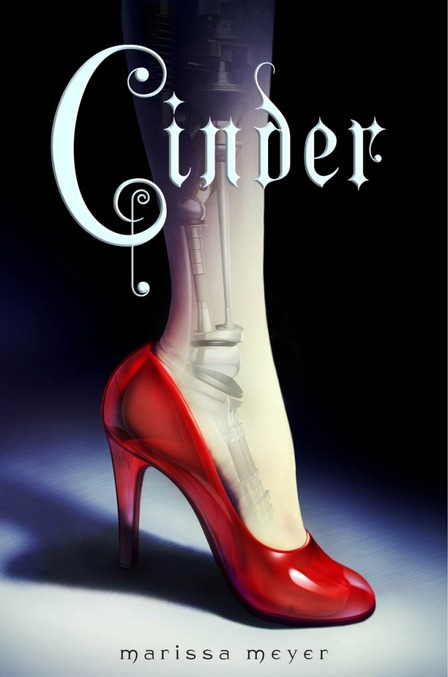
When I first heard about this book, I was skeptical. Cinderella and cyborgs? Ummm, sounds crazy.
Allow me to eat my words.
If you're looking for another gushing review for Cinder... you've found it.
Cinder
by Marissa Meyer
*Debut Novel*
Read on Kindle
Genre: Science Fiction, Fairy Tale Retelling
Big Themes: prejudice, plague, war/peace, duty
Summary:
After a terrible childhood accident, Cinder is alive but left an orphan and part machine. A plague has reached pandemic levels, and the emperor of the Eastern Commonwealth is on the brink of death as his teenage son prepares for the heavy responsibility of leading his people when they are on the brink of war with the Lunars (humans who moved and established their own nation on the moon). Cinder is a mechanic and an outcast in a society that is prejudiced against cyborgs. When the prince shows up at her mechanics booth in the market and requests help repairing an android that holds secret information, Cinder catches his attention and becomes entangled in plots much bigger than those of her evil stepmother. (Seriously, this book is so huge and so much happens that this was a very difficult summary to write. I hope I intrigued you, not confused you)
What I Liked:
First off, one of the biggest reasons I liked this book is because it's like nothing I'd read before. It was refreshing, original, and pleasantly different. Where have you ever read cyborgs, plague, and moon colonies paired with a prince, evil stepmother, and royal ball? Then throw in a war, some wontons (the story takes place in New Beijing) and a big question of what it means to be human... Bam! This is one crazy recipe, but Marissa Meyer got it all to work. I was left satisfied, but hungry for her next concoction.
Main Character: Cinder is awesome. She's strong-willed, independent, loyal, and... a mechanic! Yay to girls in traditionally male occupations! And she's got this cool little orange light that blinks when someone is lying to her! Awesome. I want one. One of the things that unnerved me at first, but I later grew to like, is that her physical appearance is never dwelled upon or described in depth. At first this bugged me because I was having difficulty picturing her. I could picture her robotic arm, leather boots, gloves, and knew her hair was in a ponytail. But I had no idea what color hair she had or how dark her skin was or what color her eyes were. In the world of YA lit, especially after Edward Cullen's bronze hair and topaz eyes were described a bazillion times, you come to expect repeated, detailed physical descriptions. I grew to appreciate that Cinder's appearance wasn't dwelled upon because it kind of sent a message that her appearance wasn't the most important thing about her. And I liked that. I really liked that. And I think that message was echoed in other scenes... but I don't want to give any spoilers...
Secondary characters: A very rich cast of secondary characters from Iko the android with a personality malfunction, to Peony the lovable little sister, to Prince Kai and his heavy responsibilities, to the mysterious and suspicious Dr. Erland. I'd love some more insight into the Lunars, but for now I think they are meant to be an enigma.
Setting: I really loved that she chose to center this story in a New Beijing. I loved the hints of Asian culture. While this book probably won't fit the definition of hard science fiction, it was far more technical than I expected from a fairy tale retelling. There are plenty of gadget references that sound sufficiently advanced. There is an especially cool section where the rebuilding of Beijing is described and how state-of-the-art technology was hidden within old world details. There was a cool side-mention of a transatlantic maglev train. The one thing I want more info on is the Lunar kingdom. It wasn't a place they travelled to in this book, but more details in future volumes is definitely expected.
Plot: Excellent pacing and suspense. I really don't want to elaborate in this category because I don't want to have any spoilers. But with a fast-spreading plague, world on the brink of war, and secret plots against the prince, you'll have more than enough to keep you on the edge of your seat. There is some predictability because the story is a fairy tale retelling. There are moments you will see coming. And if you watched any Sailor Moon as a kid... one moment will definitely come as no surprise! But there is enough fresh and original material from the sci-fi concept that you will never be bored. And anticipating the "Cinderella moments" had it's own little satisfaction when they came true.
BONUS: Thank you Marissa Meyer for writing a YA book that I could recommend to my advanced 6th graders. Some middle grade books are too easy for them. Many YA titles are too risque. There was no cursing, mild violence, and no sex (just one little kiss at the ball). It's getting harder and harder to find books that aren't pushing the boundaries. You didn't cross any lines, and still managed to write an engrossing story for teens. Hurray!
I always feel like the real testament of a great story is when I finish the book and think, "Man! That was a great idea for a book! I wish I'd come up with it!" As much as I wish I'd come up with the idea for Cinder, I think only Marissa Meyer could have pulled this off. Bravo! And can't wait for Book 2: Scarlet!
My Rating:
A full five stars. I'm already going through Cinder withdrawal and I finished the book yesterday. I'm tempted to read it again!
This book fulfilled two of my challenges:
Debut Author Challenge
Fairy Tales Retold Challenge
Sunday, January 29, 2012
Writing Resolution: Week 4
My New Year's Resolution was to write. Preferably for a novel, but any creative writing will suffice. I must have my butt in my chair behind my desk for two hours each night to write. The time frame I set up was from 6-8pm Monday through Friday. Weekly posts will report on my progress and keep me on track!
Week Four Results:
Did I write all five days for two hours? YES
Word count for the week = 3093 words
What I Learned This Week:
Anyone else write scenes out of order?
Anyone else scared of ghosts?
Anyone else scared of pink and butterflies?
And a big "woo hoo!" for keeping my resolution through the whole month of January!!!
- I didn't increase from last week's word count, but I'm okay with that because this week was rough at work. Report card time makes me want to pull my hair out.
- I did a better job of balancing my writing and reading time this week. I finished TWO books, and I am thus a much happier person. (Finished books were Liesl and Po and Cinder. Look for my review of Cinder tomorrow!)
- I'm writing a bunch of random scenes right now. Nothing is in order. I don't know if I'll hate myself later when I have to pull things together, but I'm learning about each character as I hop around. At some point I'll probably need to make some scene cards and start arranging things and figuring out what I need to write to fill in holes. I'm kind of likening my creative process to how they do movies. Don't they not film the scenes in order? And sometimes go back and re-film? And then edit everything together. Yeah. That's what I'm doing.
- Writing creepy scenes, about ghosts, at night... FREAKS ME OUT. I don't read horror books. That's the one genre I stay away from. And these will be nice ghosts, but they're still DEAD PEOPLE. And even if I know they aren't real (since they're from my head), I'm still getting freaked out. Come on Winter, hurry up and be over so I have some daylight in which to write in... and then don't get scared.
- I just wrote a scene with multiple mentions of the word pink and lots of butterflies. It kind of makes me want to hurl at the girliness of it. I'm so not a pink and butterflies person. Where did this come from? And the bigger question being... will I keep it? Is there a way to make butterflies less girly? If I mention proboscis and antennae... will that help?
Anyone else write scenes out of order?
Anyone else scared of ghosts?
Anyone else scared of pink and butterflies?
And a big "woo hoo!" for keeping my resolution through the whole month of January!!!
Thursday, January 26, 2012
Book Review: Liesl and Po
 Liesl and Po
by Lauren Oliver
Read in Hardback
Genre: Fantasy
Big Themes: death, ghosts, orphans, magic, evil adults
Summary:
With the help of a ghost named Po, two children embark on a journey to return the ashes of Liesl's father to their proper resting place beneath the willow tree. But conflict arises when there is a mix-up: the wooden box with her father's ashes is unknowingly switched with a wooden box
containing the most powerful magic in the world.
What I Liked:
First off, the cover of this book is gorgeous, which is especially worth mentioning since there are TWO gorgeous covers. The book jacket is nice, but I personally loved the cover underneath the jacket even more. Bonnie @ ABackwardsStory did a great post on the cover including a video, which is probably the best way to appreciate it if you don't have it right in front of you. Pictures don't do it justice.
Another thing I liked in the book was Oliver's use of language and descriptions. She just has a lovely way of putting things. Here's a quote from the book describing the process of becoming a ghost, as told by Po,
"He might have already begun the process of becoming part of Everything. He would begin to feel the electricity from distant stars pulsing through him like a heartbeat. He would feel the weight of old planets on his shoulders, and he would feel the winds of distant corners of the universe blowing through him." Page 45You can turn to just about any page in the book and find a gorgeous, lyrical sentence such as the one above.
And the final thing that I really appreciated was how this book was such an emotional journey for the author to write. After reading the book and reading Oliver's Author's Note, you'll have a powerful understanding of the root of this story.
Criticism:
My biggest issue with the book was pacing. Typically, a middle grade book does not take me two weeks to read. I kept waiting to get sucked into the story, but it never happened. I have two reasons why I think the pacing of this book was slow:
- The shifting point-of-views: Oliver was constantly shifting who was telling the story. So many times that I lost count of how many people narrated the story. I think this hurt the pacing in two ways. One, it didn't allow me to form a strong bond to Liesl, and actually diminished her role in her own story. Because I didn't bond with Liesl, I wasn't as invested in her story. Two, the shifting point-of-views sometimes overlapped the events they were telling. I would catch myself getting bored because another character was telling about an event from their own perspective that I'd already read from a different character's perspective.
- Heavy descriptions: Descriptions are such a tricky thing for authors. On the one hand, they can be beautiful and a delight to create. They help the reader get lost in your world. But descriptions can also slow down the pacing of the book. This is the first book I've read by Oliver, and I'd only heard good things about her. I'm still going to read Before I Fall and Delirium, but if Oliver is a description heavy author, I wish I'd known that going in. I tend to save my slower reads for long weekends or lazy summer days because they take a little extra concentration on my part. And at the end of a long work day, the last thing I want to do is concentrate... I need a fast, easy read.
I had a few logistical issues, too. While it was explained with magic, the sun disappearing for over a thousand days and people starving seemed pretty major... and required more than just magic for me to buy it. I know it was a metaphor for her own depression, so I'm really trying to not be too critical.
I also wish we'd had more bonding with Liesl's father so that we'd be more invested in Liesl's journey to put him at rest. Just a few touching moments where we see the father/daughter relationship would have been nice.
My Rating:
While there were aspects of this book that I admired and enjoyed, it isn't going on my "Middle Grade Favorites" shelf. I gave it 3 stars out of 5 on Goodreads. But maybe it deserves three and a half...
Behind the Story: Choosing Character Names
Behind the Story posts will be about what goes on behind the scenes as a writer creates their story. I'll be writing about my own writing process and sharing any tips or advice I've discovered on my own or gathered on the topic. Hopefully both readers and writers find these posts fascinating!This week's topic:
Choosing Character Names
In this week's post, I'll delve into how I go about choosing names for my characters. There's a lot of things to consider, and I definitely think certain authors have a gift for choosing the perfect names. Two authors that come to mind are J.K. Rowling and Charles Dickens. Here's what I've learned so far, but by no means am I an expert!
My own tips and tricks for choosing character names:
- Baby name websites: Best resource ever for finding character names. My favorite website is Behind the Name. You can browse or search for names, and each entry is organized much like a dictionary with pronunciation, origins, meaning, history, and popularity. I love when my names have special meaning, and I've used this website more times than I can count!
- Using sounds to your advantage: Certain sounds have certain connotations, whether you are conscious of it or not. A sharp sound is going to be more serious than sounds that long. Sorry to keep using Harry Potter for my examples, but Rowling was a wiz with names. Voldemort = Both the V and T sounds are sharp and bookend the name with their sharpness, plus the added meaning of mort as death. Severus Snape = Both the V and P sounds are sharp, and the S sound makes his name slippery to say and perfect for a spy. Whereas Neville Longbottom uses several sounds that are long and slow, particularly the O sound which is one of the slowest vowels. And his name ending in the "UM" sound just makes the poor bloke sound unsure of himself just simply in his name. I'm not an expert on this sound stuff, but as I become more aware of it, I've found it helps me in choosing the right names for my characters.
- Coming up with a list for later reference: I like to have a list of stock names that I can grab from later if a new character announces its arrival. Especially if I'm in a certain time period, I'll make a list of names I like from that period, and make short notes regarding my own reactions to the name "evil" or "sounds strong." Usually our own first impressions come with our own subconscious connections to root meanings and sounds. My lists so often come in handy when a character pops into my head fully-formed and needs a name, and usually one from my list will jump out at me. It saves me the time of pouring through websites again, especially when I'm in the throws of writing and would rather not stop.
Some other sidenotes:
Surnames have been a lot harder for me to come up with than first names. I've yet to find a single website that I love. Sometimes I have to search for surnames by time period or country in order to find what I'm looking for.
Knowing the time period of your novel is a must in choosing the right name. But what to do when your novel is in the future? When I was working on a dystopian/futuristic novel, I went with a sort of melting pot of sorts. I found names, chopped up their syllables, and made new combinations using the sound connotations and roots I already knew. It was actually great fun!
Don't be afraid to change a name if your character grows and changes. The point at which we assign a name, in a novel's infancy, is often before we've discovered the core of the novel. I've changed a character's name more times than I can count when the name doesn't feel right anymore. It's okay. And it will always be good interview fodder for those blog tours down the line ;)
What authors do you think have great names for their characters?
Do you writers have any neat tips or tricks for choosing character names?
Subscribe to:
Posts (Atom)